What was the main signpost which David pointed out to keep his son on the godly path?

(8 mins. reading time)
In my mind I picture the signpost on a hiking trail at a conservation area near our home which has several trails, each with their own coloured-coded signs. If you want to take the green trail, then follow the green signs. If you want to follow the yellow trail, then take the yellow signs. It’s clear that to stay on the trail you need to follow the coloured signs. Following the yellow signs will never put me on the green trail. David began by describing the trail to avoid.
David presented the signpost using a form of Hebrew poetry known as synthetic parallelism, whereby subsequent phrases are used to develop the original thought (see Psalms for Nerds post). Verse 1 develops a progressive warning to create a clear signpost for the godly path.
1 Oh, the joys of those who do not
follow the advice of the wicked,
or stand around with sinners,
or join in with mockers. (NLT)
The warning, or the trio of warnings, show a gradual progression – don’t walk, don’t stand, and finally don’t sit with the ungodly. Straying onto the path of the ungodly is not a 100m sprint, something that is accomplished in ten seconds. It’s a gradual, almost imperceptible progression.
The progression of warnings could also be compared to wading into a stream of moving water.
Ankle deep (1st warning): “follow the advice” or “walk in step”
Knee deep (2nd warning) : “stand around with” or “stand with”
Waist deep (3rd warning) : “join in with” or “sit in the company of”
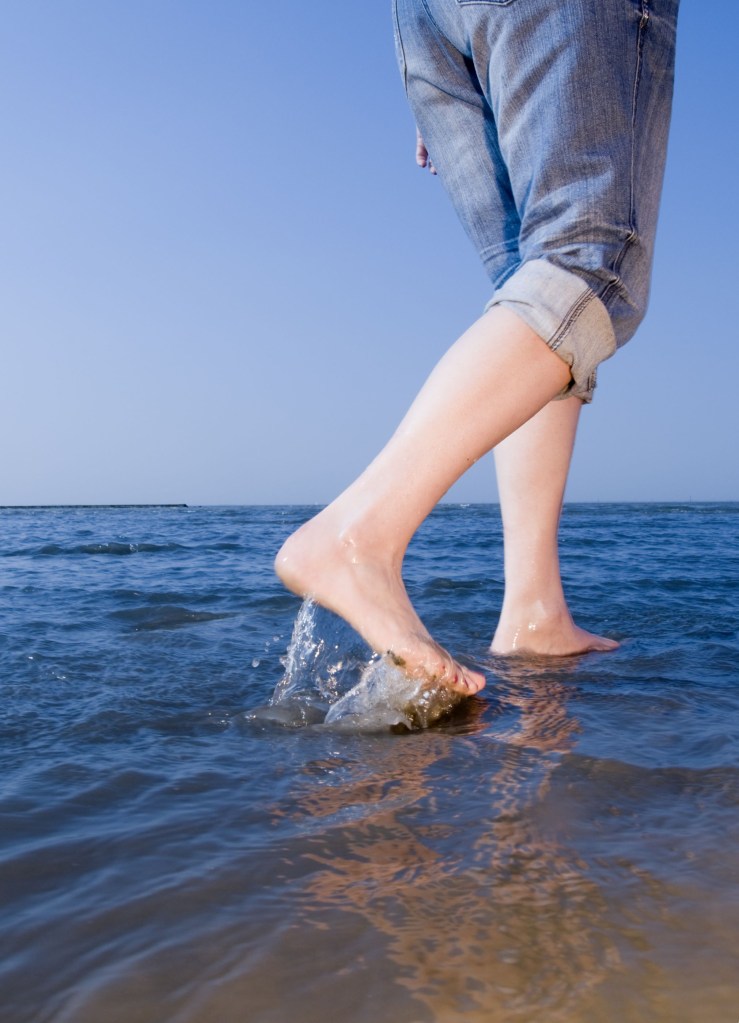
The path to ungodliness begins simply by walking alongside another ungodly person. We are surrounded by people wanting to give us advice on the road of life. We all find ourselves here. This is a casual conversation, and there is always an opportunity to accept or dismiss the counsel provided. We are only in ankle deep and the stream does not have any ability to move us in the direction of flow.
If we warm up to the initial influence, the natural progression moves to more intentional engagement and acceptance. Standing with someone has moved influence from an acquaintance to a companionship. The person has moved further into the stream from ankle deep to knee deep, no longer testing the waters but choosing to move into them. Influence is no longer casual but intentional. At this point the flow is more substantial but not enough to sweep a person away.
As a drainage engineer, I have examined life safety and flowing water and I have learned that when water depth and velocity combine at a point between knee and waist depth, a person will be dislodged from the streambed and be swept downstream. In terms of David’s warning, this represents the third and final step.

As the person surrounds themselves with more like-minded individuals, they now find themselves in the company of the ungodly. The final step is the “all in” step. The person is now sitting down and has joined their company. They have now fully embraced the ideals of the group or company. Their feet have been swept off the streambed and they are carried away by the flow.
The psalmist described this group as scoffers. We might refer to them as “know-it-alls”. They are people who are drunk with their own cleverness, and no one can counsel them. This company is characterized by cynicism, gossip, and looking down at those who don’t see things the same way. Andy Stanley describes scoffers as “fools on steroids.”
“While the overall shift is dramatic, the progression is incremental. This is drift.”
The essence of the warning is to be careful with what we become attached to or tethered to, the company that we keep, or the community we surround ourselves with. Drifting is not an individual process but one that takes place in community.
Caution Tape

Our relationships include both godly and ungodly people. We cannot cloister ourselves with only the godly and completely ignore the ungodly. This is contrary to Jesus’ own life where he was described as a friend of sinners and tax collectors. However, the friends that Jesus intentionally chose for his inner circle, his twelve disciples, were not the ungodly.
The issue is one of influence and attention. Are we influencing the ungodly or vice versa? Does walking with our closest companions focus our attention on ourselves or on God?
Echo Chambers
With the advent of social media, the journey from walking to standing to sitting has accelerated exponentially compared to David’s and Solomon’s times. Social media makes it easy to connect to and share information with virtually anyone online, providing a quick and easy way to connect with our friends and other like-minded people, and giving us access to an unprecedented amount of content.
The feed algorithms in social platforms, such as Facebook and Twitter, look at our selections and then automatically suggest other similar posts without asking us for our preferences. The feed algorithm provides links to information consistent with our previously viewed sites. The result is that we can quickly find ourselves connected to very focussed groups with whom we share narratives.

For example, if I were to look at my wife’s social media feed it would consist primarily of sites related to knitting or Cricut. No matter how many knitting or Cricut related sites she clicked on, the feed algorithm would never suggest the topics that could end up on my feed like road cycling or the Chicago Blackhawks. Unless, of course, there was a knitting pattern for a Blackhawks sweater! This phenomenon is referred to as the “echo chamber” effect on social media. 1
Echo chambers are generally defined as, “environments in which the opinion, political leaning, or belief of users about a topic gets reinforced due to repeated interactions with peers or sources having similar tendencies and attitudes.” 2 Knitting and cycling are one thing. But as the definition states this phenomenon spills over into all sorts of environments.
The image below is an example taken from Twitter during the 2010 U.S. midterm elections and shows how polarized and segregated groups emerged as people retweeted political hashtags. The nodes represent tweets, and the colours represent political preference (blue nodes are Democrat tweets and red nodes are Republican tweets). 3 There are a few blue nodes on the red side and virtually no red nodes on the blue side. The Democrats are hanging out together as are the Republicans. One group is not winning people over from the other side. It’s all about influence!
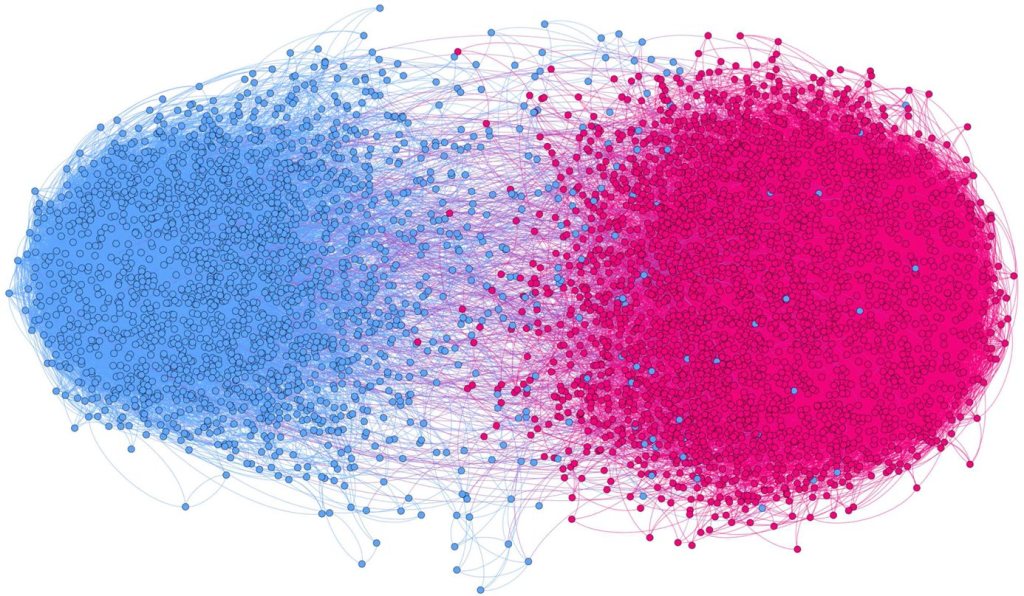
Social media has two main drivers, social sharing and linking. While this may not have been the original intention of social media platforms, the way in which people use them has resulted in very focussed groups of like-minded people. No walking or standing required, only casually scrolling through your social media feed. In today’s digital environment, drift can happen much quicker than in the courts of David’s palace.
Drift and Community
What is the impact of community on us? Solomon warned that we will become like the people that we embrace. From Proverbs 12:20, “Walk with the wise and become wise, for a companion of fools suffers harm.” A companion is someone who has our attention because we have chosen to walk with them. These are the people close to us. Choose them carefully, Solomon warned, because eventually, step by step, we will become like them. Their attitudes, thinking and values will become ours. The impact of community cannot be underestimated.
In a recent message, our pastor summed up the power of environment using Psalm 1:1 in the following way,
“Where you sit determines what you see and hear. What you see and hear determines what you think. The way you think determines how you will act.” 4
Up Next
Paul provides similar to advice to Timothy when he says, “Do not waste time arguing over godless ideas and old wives’ tales. Instead, train yourself to be godly” (1 Timothy 4:7). Staying close to God requires intentional and incremental steps. The psalmist’s next words provide the way of training for godliness.
Notes:
- Cinelli, M., De Francisci Morales, G., Galeazzi, et al., The echo chamber effect on social media. Proceedings of the National Academy of Sciences of the United States of America, Vol. 118, No. 9, 1-8 (2021). https://www.pnas.org/doi/epdf/10.1073/pnas.2023301118
- M. Cinelli et al.
- Sasahara, K., Chen, W., Peng, H. et al. Social influence and unfollowing accelerate the emergence of echo chambers. J Comput Soc Sc 4, 381–402 (2021). https://doi.org/10.1007/s42001-020-00084-7
- Nathan Blais, Circle Up Sermon Series, Part 2: Choose Your Circle, Pathway Life Church, September 18, 2022.
 Head and Heart Collide
Great stuff Henry. Your perspective as an engineer really makes familiar words come to life.
LikeLike