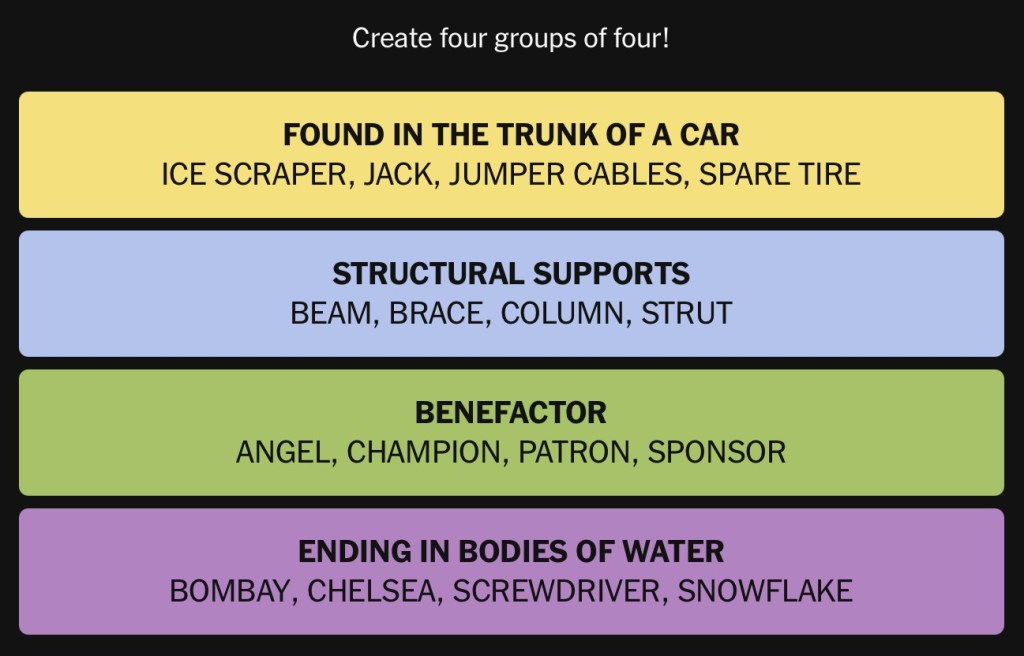
I have family members who enjoy the New York Times daily word game “Connections.” The game consists of sixteen random words that need to be organized into four groups of four, each group with its own distinct theme. Some of the groups are easy to figure out, like the words interval, period, span and stretch are examples of duration. Others are not as straightforward, such as fair, marple, popular and psalm. The connecting theme for these words is revealed at the end of the blog. Speaking of connections, verses 5 and 6 in Psalm 24 provide the following four words which got my attention – seek, righteousness, worship and blessing.
(Reading time – 11 mins.)
5He will receive a blessing from the Lord
And righteousness from the God of his salvation.
6 This is the generation of those who seek Him,
Who seek Your face—even Jacob.
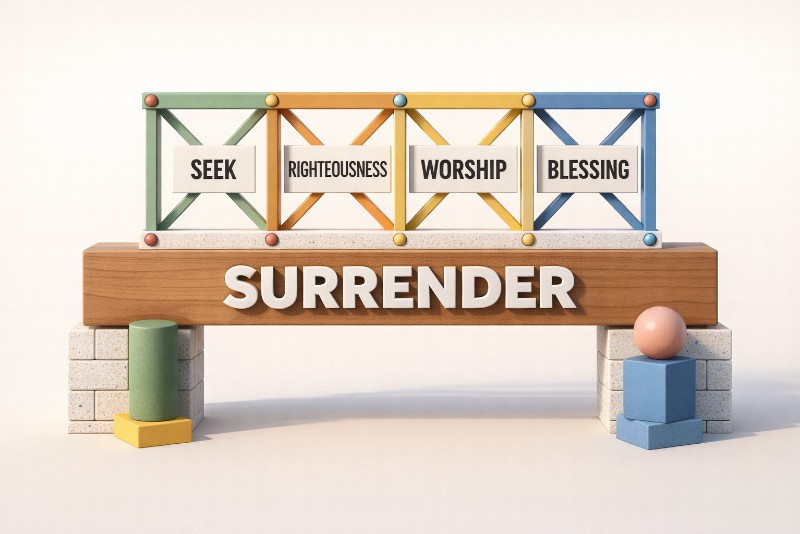
In the context of Psalm 24, these two verses are like a bridge in the middle of a poem connecting two riverbanks. On one bank, described in verses 1-2, there is separation between the Creator and humans. The opposite bank, depicted in verses 7-10, paints a different picture – a celebratory procession of the warrior King and his followers entering the King’s city together.

© Helmut Mülnikel
Recap
The previous posts covered the stories of Abraham and Moses and showed that coming into God’s presence does not consist of completing a checklist of actions but by walking through a crisis on the way to complete surrender. The theme of surrender, as opposed to piety or performance, was also told in the sequence of poems from Psalm 15 to Psalm 24. God’s deliverance of King David at the centre of the poems reframed the question from, “who” may ascend the hill of the LORD to “how.” The “how” question was answered by God’s loyal actions on behalf of his faithful King David and the future Messiah. It is through God’s deliverance of his faithful King that all those who seek him will be invited into his presence.1
Let’s consider each of the four connecting words – seeking, righteousness, worship and blessing.
Seeking
We’re all seeking something. Since being banished from Eden, we’ve been trying to find our way back, but we are all searching in different directions. The prophet Jeremiah commended those who sought the LORD, even when things were decidedly not going their way, “The LORD is good to those whose hope is in him, to the one who seeks him; it is good to wait quietly for the salvation of the LORD.” (Lam. 3:25-26)
One of Psalm 24’s themes is seeking, also expressed as climbing the mountain of God. The image of ascending the hill of the LORD also describes the annual pilgrimages for Jewish festivals. Jerusalem is perched on a mountainous ridge that divides Israel vertically into east and west. Moving either east or west from Jerusalem, a person would descend the hill country either towards the Mediterranean Sea to the east or the Euphrates River to the west. The concept of seeking God and ascending the hill of the LORD was built into the Jewish DNA.
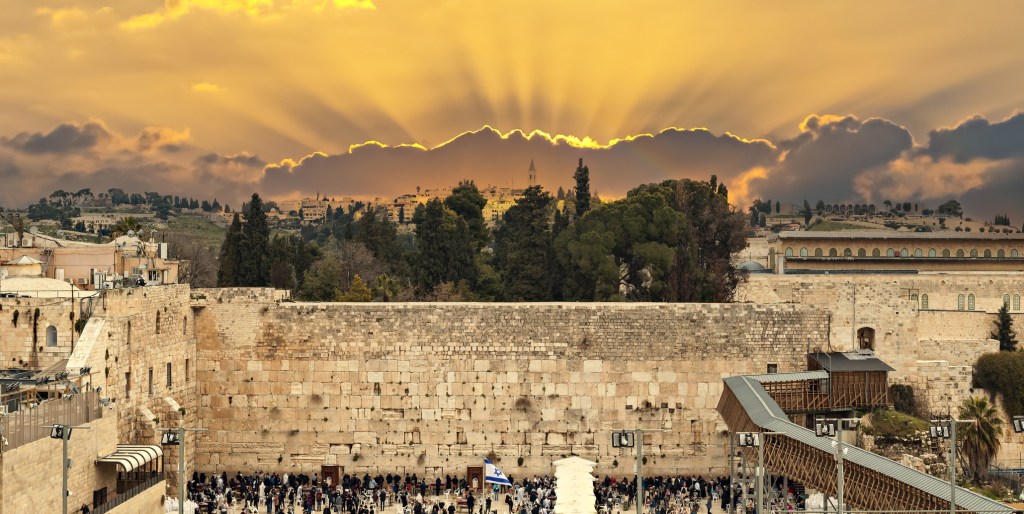
In his book, Leap Over a Wall, Eugene Peterson described the main route from the east that he observed while visiting Israel. He described a modern highway that runs from Tel Aviv to Jerusalem. This highway followed an ancient roadway, traveled for 2,500 years by pilgrims making their way to Jerusalem for worship. Pilgrims converged from three directions onto this old path: west from the port of Joppa, south from the coast plain of Egypt, and north from the coast plain of Syria. Travelers would funnel onto this highway and ascend step by step to the place of worship in Jerusalem. Some of these pilgrims would have been travelling for weeks, some for months. Jewish people scattered into all nations returned for the feasts of Passover, Weeks (Pentecost), and Booths (Tabernacles).2
What were the Jewish pilgrims hoping to receive by ascending the hill of the LORD? According to verse 5, it was to receive blessing and righteousness from God!
Righteousness
The story of righteousness begins with a man named Abram whom God called to leave his country, his people, and his father’s household to go to a land that God would show him. God promised to make Abram into a great nation and bless the nations of the world through him. Abram obeyed, gathered up his household and left. Years later, Abram still had no children, and again God promised him an heir and offspring as numerous as the stars. Abram believed the LORD, and this was credited to him as righteousness.
Righteousness is often associated with behaviour characterized by accepted standards of morality, justice, virtue, or uprightness. What “morally justifiable or upright behaviour” did Abram show by believing God? Had he done some mighty work in God’s name? He had not even perfectly trusted God in his journey. He hadn’t done anything except listen to God’s words and accept them as true. And for that Abram was counted as righteous.3
It’s human nature to want to work our way into God’s presence – to climb the hill of the LORD – to be considered righteous. This is not God’s way. Ann Voskamp captured the idea of earning righteousness through performance when she described the return of the prodigal son,
Like the prodigal son we are wearing dirty garments as we approach our father. However, the son wanted to work his way back into relationship as a servant – on his own terms, appealing to his father’s generosity. His father had a different idea and put on the family robe and ring and reinstated him as son. The garment of righteousness given to him not earned so none of us could boast in it or take credit for ‘cleaning ourselves up,’ This has to be done externally by God.4

Isaiah also described righteousness as receiving a garment, “I am overwhelmed with joy in the LORD my God! For he has dressed me with the clothing of salvation and draped me in a robe of righteousness” (Isa. 61:10). Abram’s righteousness was not achieved by climbing the mountain of performance. It was a gift because he put his faith in God’s promises.
Paul wrote that New Testament believers who put their faith in Christ the Messiah, the same Messiah who ascended the hill of the LORD on their behalf, would receive the garments of righteousness from God. “God made him who had no sin to be sin for us, so that in him we might become the righteousness of God” (2 Cor. 5:21).
Having sought the LORD and received the garment of righteousness the natural response is worship.
Worship
Worship begins with the humble acknowledgment of who God is and what he has done in all his power and glory. King David expressed it well in Psalm 95:6-7, “Come, let us worship and bow down. Let us kneel before the Lord our maker, for he is our God. We are the people he watches over, the flock under his care.” For King David the acknowledgement led to an active response described in Psalm 43:3-4, “Lead me to your holy mountain, to the place where you live. There I will go to the altar of God, to God—the source of all my joy. I will praise you with my harp, O God, my God!”
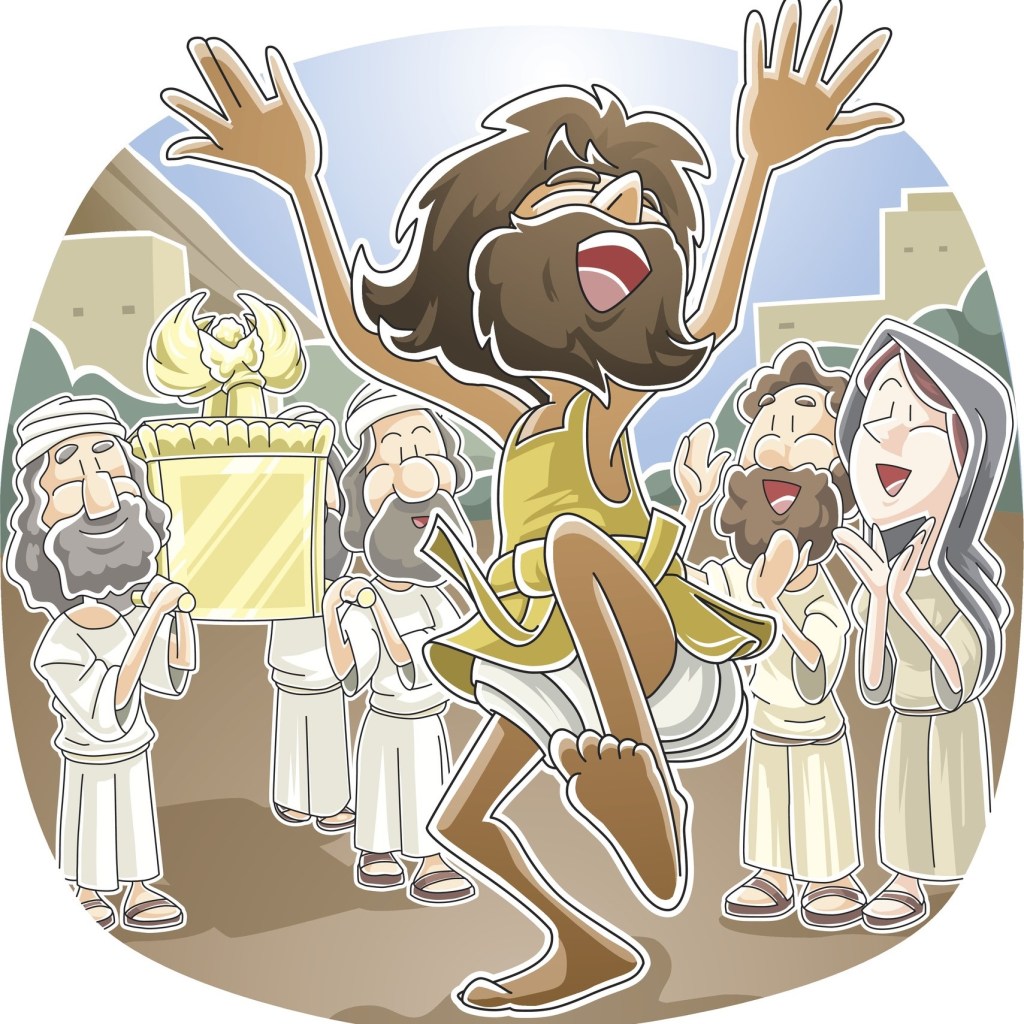
In the Old Testament there were two altars associated with the temple worship: an outdoor altar for presenting a sacrifice to purify from sin, and an indoor altar where the priests continually burned incense to represent the prayers of the people. King David approached the outdoor altar, not out of compulsion or duty, but in sheer joy for the opportunity to praise God.
The apostle Paul echoed the idea of bringing an offering as part of worship in Romans 12:1, “And so, dear brothers and sisters, I plead with you to give your bodies to God because of all he has done for you. Let them be a living and holy sacrifice—the kind he will find acceptable. This is truly the way to worship him.”
For the New Testament believer, worship was not an individual event but, “the heartbeat of the believer’s existence, a lifelong celebration of the worthiness of God. To worship is to respond with one’s whole being in adoration, humble submission, and obedience to God.”5
God’s response to our worship is blessing.
Blessing
The word blessing brings us full circle to the first connection word: seeking. What are we seeking? Are we not seeking God’s presence, and in that presence God’s favour or blessing? The first word in Psalm 1 is blessed. The Royal Advice post described blessed as, “as sense of well-being, of wholeness, of happiness.”6 Each of Psalms 1, 2 and 3 describe different elements of blessing: Psalm 1, fruitfulness and abundance; Psalm 2, safety, security and stability; and Psalm 3, salvation and deliverance. The remainder of the book of Psalms is full of poems describing God’s blessing.
Jesus’ nine-part opening to the Sermon on the Mount begins with the same word, blessed. Tim Mackie from the BibleProject podcast explained that blessed is equivalent to the phrase “how good is life for” or “how happy is the ideal.”7
Blessed describes the ideal way to be human.
God’s orientation towards his creation has always been blessing. In the beginning God blessed the animals, humanity and the Sabbath Day. The Genesis blessings, however, were not one-time, static proclamations. There was continuous providence where food was given to all people and animals. Part of God’s blessing was the undergirding and maintenance of daily life. Leslie C. Allen described the continuous nature of God’s blessing, “It is Yahweh who is the believer’s sustenance, his ultimate life support system and gives the source of all that fulfills his potential.”8
In the Garden of Eden, Adam and Eve walked with God, there was enough for everyone, and they were meant to rule. The whole package was the blessing.
In Psalm 24, the divine blessing, or taste of Eden, is the sequel to worship. The Jewish pilgrims who came to the annual festivals were given a priestly benediction before they returned home. Psalm 121 is an example of such a priestly benediction. The essence of the benediction was that Jewish pilgrims met with God in temple worship and God went back with them to their everyday life as a guardian, protector and provider.
Rewind
Have you figured out the connecting theme for the words fair, marple, popular and psalm from the beginning of the post? According to the New York Times Games app, the connecting link is, “trees plus a letter” (i.e. fair minus a letter is fir, etc.). Not intuitively obvious! What is the theme undergirding the Psalm 24:5-6 words seeking, righteousness, worship and blessing?
Surrender!
Seeking is surrendering our perspective that we are at the centre, and acknowledging that there is something holy, otherworldly, something bigger than us.
Righteousness is surrendering our performance to achieve good standing before God and instead receiving and putting on the garment of righteousness by faith.
Worship is surrendering ourselves to God as an offering. It is also surrendering any obstacles that get in the way of our relationship with God.
Blessing is surrendering our need to be in control by acknowledging that something bigger than us continually protects and provides for us as the world keeps turning between Eden and the new earth.
Picture This
In my engineering brain, and with the help of AI (Copilot), I imagine the Surrender Connections bridge to look something like this:
Up Next
The call and response announcing the arrival of the victorious King at the city gate.
Notes:
- Carissa Quinn, The Arrival of the King: The Shape and Story of Psalm 15–24 (Bellingham: Lexham Press, 2023) 151.
- Eugene Peterson, Leap Over a Wall: Earthy Spirituality for Everyday Christians (New York: Harper Collins, 1997) 146.
- Got Questions, https://www.gotquestions.org/difference-righteousness-holiness.html
- Ann Voskamp, The Greatest Gift – Unwrapping the Story of Christmas (Carol Stream: Tyndale House, 2013) 59.
- Got Questions, https://www.gotquestions.org/definition-of-worship.html.
- Eugene Peterson, As Kingfishers Catch Fire: A Conversation on the Ways of God Formed by the Words of God (Colorado Springs: Waterbrook Press, 2017) 107-108.
- Bible Project Podcast, The Good Life According to Psalm 1 (February 23, 2026) https://bibleproject.com/podcasts/the-good-life-according-to-psalm-1/
- Leslie C. Allen, The Psalms Word Biblical Themes (Waco: Word Books, 1987) 85.

