
Have you ever had an experience where someone whom you held in high esteem did or said something which resulted in the destruction of your esteem for them? It could have been a leader, an elite athlete, or a close family member. Maybe one minute you would have heartily endorsed them, but because of their actions or words, you would now be embarrassed to be associated with them.
(Reading time – 11 min.)
This happened with one of our daughters when she was at an impressionable age. We would hear regularly about one of the boys in her kindergarten class who was the “coolest kid” in the class. Then came the day when he pulled the fire alarm, and the entire school had to be evacuated. After that episode, he was not the “coolest kid” in the class!
Something like this happened with the relationship between the Israelites and the ark of the covenant during the time of Eli the priest. One moment the ark is being trotted out to the battlefield for a victory endorsement against the Philistine army. The ark was captured by the Philistines and seven months later; after receiving the ark back from the Philistines, the Israelites are begging for the ark to be sent away.
What? Read on!
Opposing the Proud
In the Show Me the Glory post, we saw how the Israelites became arrogant in a crucial battle against the Philistines, and instead of praying, they brought out the ark of the covenant in expectation that it would award them a victory. As punishment for their presumption and pride, Israel lost the battle, the ark was taken captive, and Shiloh, the religious centre of Israel, was destroyed (1 Sam. 4:3-11).
The Philistines took the ark and placed it in the temple of their god, Dagon. The God of Israel responded by thoroughly defeating the Philistines and their idols through plague instead of warfare. After seven months of a deadly plague, the Philistines sent the ark back to the Israelite border town of Beth Shemesh (1 Sam. 5:1-6:12).
The point was clear—God was not Israel’s guarantee of victory, and he opposed pride among both the Philistines and the Israelites. Israel was to remain humble and obedient if they wanted to experience God in the covenant relationship that he had established with the nation in the time of Moses at Mount Sinai.1
Exalting the Humble
Several years earlier, Shiloh was where Hannah had turned to God in prayer and begged him for a child. She promised that if given a child she would give the child back to God. God blessed Hannah with a son, Samuel. When he was weaned, Hannah returned with him to the tabernacle and gave Samuel back to the Lord in service to Eli. As Hannah and her husband gave the customary sacrifices, Hannah offered a prayer describing how God opposed the proud, exalted the humble, and how, despite human evil, God was working out his purposes.2
In her book Waymaker, Ann Voskamp describes Shiloh as the place, “where the tabernacle once stood with the ark of the covenant for 369 years in the holy of holies, where the people of God came from all over the nation to stand and directly connect with God. Generations of the entire nation of Israel pilgrimaged to Shiloh, the sacred heart of the nation.”3
The Creator of everything that exists couldn’t be confined to a tent, or a box, but it was in that sacred space that Hannah experienced heaven and earth overlapping.
Hannah’s posture of humility stood in direct contrast to the pride of the Israelite leaders who had trotted the ark into the battlefield. With the return of the ark, the Israelites at Beth Shemesh were at a crossroads. Now they are without a tabernacle and without the spiritual guidance of Eli the priest who died when he heard the news that the ark had been captured. They were in a very fragile and vulnerable position. They needed wise, faithful leaders. Would they let God move them to do his work, or would they again try and move God to get him to do their bidding? Door number one, humility; or door number two, pride.

Questions
The people of Beth Shemesh initially rejoiced at the ark’s return. In an act of worship, they made firewood out of the delivery cart, and then sacrificed the cows that pulled the cart. They had a great start but then they desecrated the ark by opening it and looking inside (1 Sam. 6:19).
We don’t know why the Israelites decided to look inside the ark. Maybe they wanted to make sure that the Philistines didn’t remove any of the sacred items? In their pride and remembering the ark’s failure to deliver them in battle, perhaps they felt that there wasn’t any power left in the ark. Was God’s presence still within the ark?
According to God’s instructions, only the Levites were permitted to move the ark, and even then, they were not allowed to touch the ark, never mind look inside, without facing death (Num. 4:5;15;20). Over seventy men were killed in Beth Shemesh for their disobedience, and the people mourned greatly over their loss. “Who is able to stand in the presence of the LORD, this holy God,” they cried out (1 Sam. 6:20).
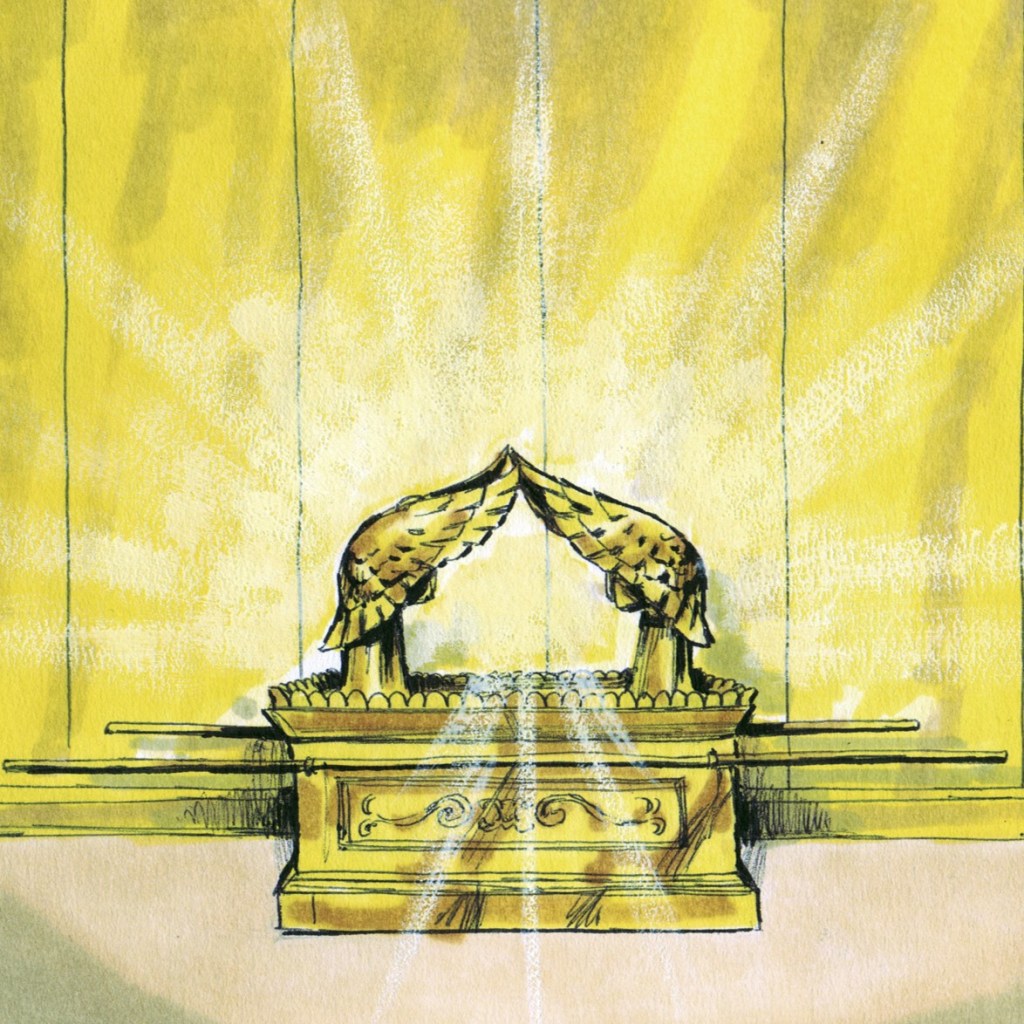
The community of Beth Shemesh collided with the holiness of God, a holiness that could not coexist with their sin. When the neighbouring nations worshipped the gods of their own making, they brought the gods down to their level. When the Israelites approached the LORD their God, God called them up to his level.4
God’s instructions concerning the ark contrasted greatly with the religious practices of foreign nations. The Egyptians, for example, could purchase amulets and potions and handle their idols.5
The God of the Hebrews could not be handled or reduced to common elements. He is greater than anything in his creation.
Looks like they chose door number two!
The Big Question
Ever since receiving the stone tablets on Mount Sinai, the Israelites had no doubt of God’s presence. He was the cylindrical pillar of fire stretching from the desert floor to the night sky that served as a trail guide. The people knew all about the cleansing rituals of the tabernacle and the animal sacrifices for purification. In his book, Disappointment with God, Philip Yancey summarized the Israelites relationship with God, “A God of plagues and blood on the doorpost, a God who parts the seas and floods the earth, a God with a heavy hand of deliverance and a heavy hand of judgment – awesome in power but hard to get to know.”6
The big question for the Israelites was not, “Does God exist?” but “Is God knowable?”5
The ark, with its tablets of the covenant, served as a continual reminder to the Israelites not only of God’s holy presence but also of God’s demands on their lives as his chosen people. Yancey elaborates on God’s requirements for the Hebrew nations, “For Israelites to live in proximity to a holy God, nothing – not sex, menstruation, the content of clothing fabric, or dietary habits – could fall outside the purview of his laws. Being a ‘chosen people’ had a cost. Just as God found it nearly impossible to live among sinful people, the Israelites found it nearly impossible to live with a holy God in their midst.”6
As North American protestants, we are familiar with the phrase ‘personal relationship with God.’ If you want to know what kind of ‘personal relationship with God’ the Israelites enjoyed, listen to the words of the worshippers themselves: ‘We will die! We are lost, we are all lost! Anyone who comes near the tabernacle of the LORD will die.’’7

Perhaps you have heard someone say or maybe even thought to yourself, “if only I experienced a miracle firsthand, then I would believe and trust in God.” The Israelites are living testimony that bearing witness to God’s power did not draw them closer to him but had the opposite effect. It exposed their sinfulness, and like Adam and Eve in the garden, they wanted to hide. The Israelites did not want to get to know this holy God who pursued them.
We are worlds away from these Israelites, but are our hearts any different?
By opening the ark to look inside, the Beth Shemesh community wanted to see God’s glory. They got their wish, but it was the last thing they saw. God did not do their bidding, and neither does he do ours. Instead, God says “if you want to see my glory, believe without seeing and follow my ways. I want to know that you are all in – that you have no other gods before me. I want to know that you are exclusively mine by doing the things I asked you to do.”
When we are faithful to God, then he will show us his glory.
Forgotten
The peoples’ response to the Beth Shemesh disaster echoed their Philistine neighbour’s response, “Where can we send the ark from here?” They experienced the judgment of a holy God and instead of repenting in humility they wanted to get away from God’s presence. They decided to send the ark away to Kiriath Jearim about sixteen kilometres northeast to the house of Abinadab.
The ark sat in Kiriath Jearim for twenty years like an unwanted box in the attic. During this time the Israelites mourned the reduced status of the ark and feeling that God had abandoned them because of the episode with the community of Beth Shemesh (1 Sam. 7:2).
After twenty years of mourning and sorrow by the Israelites, Samuel, in his first publicly recorded act, told the people that if they were truly sorry, then they should do something about it. He urged them to get rid of the foreign gods in their midst. God had not abandoned his people – his people had abandoned their God for the foreign gods of their neighbours.
God insisted that his people worship him exclusively.
Samuel summoned the people to Mizpah where they fasted and confessed their sin to the God. The Philistines heard of the gathering, mobilized their army and advanced to Israel. While Samuel was still sacrificing the burnt offering, God spoke with a mighty voice of thunder, which threw the Philistine army into such a confusion that the Israelites managed to defeat them (1 Sam. 7:5-13). For the remainder of Samuel’s life, the Philistines remained subdued.
In the rest of Samuel’s life, the ark was never mentioned again. These Israelites, like their desert wandering ancestors, preferred an intermediary in their relationship with God. Working from Mizpah as home base, Samuel traveled around Israel providing spiritual leadership to the people. Meanwhile the ark remained forgotten at the house of Abinadab in Kiriath Jearim for another eighty years.

Mountain High to Storage Unit Low
From the smoke and lightening of Mount Sinai to the house of Abinadab, the 400 years of the ark’s existence writes a story of God who desired a relationship with his people, but who would not lower his standard of holiness. God’s holiness shone a bright light on the Israelites sinfulness, and they wanted to get out of the light beam. While they enjoyed the benefits of God’s deliverance, they had great difficulty when the same God invited them to realign their affections to him to rise and meet him.
Instead, the nation turned to mediators like Moses and Samuel who recognized God’s holiness and rose up to meet him. God’s presence fascinated Moses and Samuel because they recognized him as other worldly and met him in humility and obedience. The Israelites, in their pride, brought God down to their level, treated him like a good luck charm and when they didn’t get the desired outcome switched allegiance to the gods of their neighbours.
Up Next
Who will bring the ark out of storage and return it to its former glory in the tabernacle?
Notes:
- Bible Project, Guides to the Book of Samuel https://bibleproject.com/guides/books-of-samuel/
- Guides to the Book of Samuel
- Ann Voskamp, Waymaker (Nashville: W Publishing, 2022) 187.
- Eugene Peterson, Praying with the Psalms (New York, HarperOne, 1993) July 24.
- Life Application Study Bible – Third Edition, (Carol Stream: Tyndale House, 2019) 204.
- Tyler Staton, Praying like Monks, Living Like Fools (Grand Rapids, Zondervan) 2022 56.
- Philip Yancey, Disappointment with God (Grand Rapids, Zondervan, 1988) 78.
- Disappointment with God, 78.
- Life Application Study Bible, 204.
 Head and Heart Collide
One thought on “Familiar to Forgotten”