
What comes to mind when you hear the word, Messiah? Is it the 2020 Netflix Messiah television series? Handel’s great musical composition? Or perhaps a promised and expected deliverer to an oppressed group or nation?
(11 mins. reading time)
In verses 4 to 6 of Psalm 2, God provided a measure-for-measure response to the three-fold rant of the nations that we considered in the previous post (Big Plans).
4 “But the one who rules in heaven laughs.
The Lord scoffs at them.
5 Then in anger he rebukes them,
terrifying them with his fierce fury.
6 For the Lord declares, “I have placed my chosen king on the throne
in Jerusalem, on my holy mountain.”
The nations roared at God – God laughed at them.
The nations took a stand against God – God terrified them with his anger.
The kings declared their rebellion – God responded in kind, “let me introduce you to my king, my anointed one.”
Who is the anointed one, and what is the significance of anointing?
Selected for Smearing
The Hebrew word mashiach or, in English, Messiah means “anointed one” or “chosen one.” The Greek equivalent is the word Christos or, in English, Christ. The name “Jesus Christ” is the same as “Jesus the Messiah” or literally, Jesus the “anointed one.” 1
The Bible Project’s Anointing series described anointing as a practice of smearing oil on people and items or locations. The first example of anointing in the Bible occurred when Jacob smeared oil on a rock which had been his pillow after he dreamt of a portal between Heaven and Earth. Jacob declared “Surely the LORD was in this place, and I wasn’t even aware of it! What an awesome place this is. It is none other than the house of God, the very gateway to heaven!” Jacob renamed the place Bethel meaning “house of God,” and he poured oil on the rock (Gen. 28:10-18).

Fast forward 300 years to the Israelites building a tabernacle in the wilderness. They anointed the tent and its various worship utensils with oil, marking it as a place where God’s heavenly presence came down to earth. Moses then anointed his brother Aaron and Aaron’s sons as the first priests. The priests represented God on earth, and they represented the people to God. The priests became the first anointed ones or Messiahs.
Fast forward another 350 years to when Israel’s leaders asked Samuel for a king like their neighbours. King Saul and the subsequent kings were anointed with oil to set them apart as leaders and to mediate God’s heavenly wisdom to the nation. These kings also became ‘anointed ones’ or Messiahs.
From the Bible Project podcast, “The ritual of using oil was very specific to select someone and anoint them, to commission them, to appoint them as a representative for everyone else, marking them as a gateway between Heaven and Earth. A guide, a mediator, someone whose feet are on the ground but who can then bring the divine down. A spot where God’s presence overlaps with earth, a portal between Heaven and Earth. That can be a walking, talking bridge between Heaven and Earth in the form of a prophet or a priest or a king.” 2
Mixed Bag
When the Jewish people read the Hebrew Bible, and they came across the word Messiah, they would have pictured any number of historical priests, kings or prophets. The person who got the most page time as Messiah is King David. From the thirty-nine times the word ‘anointed one’ or Messiah appears in the Old Testament, the vast majority are related to the story of David. David’s story is the most thorough portrait of what it means to be ‘the anointed’. 3
While it sounds awesome to be selected as a walking, talking bridge between Heaven and Earth, it was not a glorious life. David’s life provided a dual portrait of what it meant to be the anointed one. One portrait is the victorious confronting of Goliath and driving out oppressors from the land. Alongside the victories though is the portrait of David humbly and patiently waiting upon God for deliverance from adversaries. There is a back and forth between the “victorious smash your enemy” Messiah, and the “crying on my knees” Messiah.
“To be anointed, therefore, is a mixed bag, a most unwelcome calling because it marked out people for exaltation that only comes after a lot of hardship.” 4
Not everyone who was chosen as an anointed one successfully filled their roles.
How to Build a heaven to earth Bridge – People’s Plan
When the Israelite leaders asked Samuel, their Judge and prophet, for a king to rule over them instead of God, God gave them the man that they wanted: Saul, the son of a wealthy, influential Benjamite. Saul was described as, “the most handsome man in Israel – who stood head and shoulders taller than anyone else in the land” (1 Sam. 9:1-2). Saul represented the ideal visual image of a king. He had the essential qualities to be a good leader – physical appearance, courage, and action. 5
He immediately put those leadership qualities on display when the Ammonite King Nahash, whose name means snake, led his army against Israel. Saul and Samuel led an army of 330,000 men that completely routed the Ammonites. “The remnant of their [Ammonite] army was so badly scattered that no two of them were left together” (1 Sam. 11:11). All seemed to be going well for Saul, the anointed one, as he proved his worth by crushing the snake. After this victory the people made Saul their king in a solemn ceremony before the LORD.
While Saul was God’s chosen leader or Messiah, this did not mean he was capable of being a king on his own. After a good start, his repeated decisions to rely on himself instead of obeying God’s commands cut him off from God. In Samuel’s farewell address to the nation, he reminded them, “But you were afraid of Nahash, king of Ammon, you came to me and said that you wanted a king to reign over you, even though the LORD your God was already your king. All right, here is the king you have chosen. You asked for him, and the LORD has granted your request” (1 Sam. 12:12-22).

In King Saul the people got what they asked for, but he was not the leader they needed. Saul did not fulfill the role of the ‘anointed one,’ – the walking, talking bridge between Heaven and Earth. Sometimes, like on this occasion, God gives the people what they asked for so that in the future they might trust his wisdom instead of asking for their own way.
How to Build a heaven to earth Bridge – God’s Plan
God sent Samuel on a mission to the house of Jesse to privately anoint a new king. What kind of person did God choose? Samuel took one look at Jesse’s oldest son, Eliab, and thought, “Surely this is the LORD’s anointed.” God’s response was, “Don’t judge by his appearance or height. The LORD doesn’t see things the way you see them. People judge by outward appearance, but the LORD looks at the heart” (1 Sam. 16:6-7). Samuel watched Jesse’s seven sons parade past, but the LORD had chosen none of them. Samuel asked Jesse, “Are these all the sons you have?” “Oh yeah,” Jesse replied. “There’s the youngest one, but he’s out in the fields watching the sheep and the goats.” Jesse thought so little of David’s prospects that he didn’t even invite him. Ouch! Like Samuel, Jesse was focused on the outward appearance, while God was concerned about the heart. Samuel anointed David as king, and the Spirit fell on him and empowered him to fulfill this new commission.
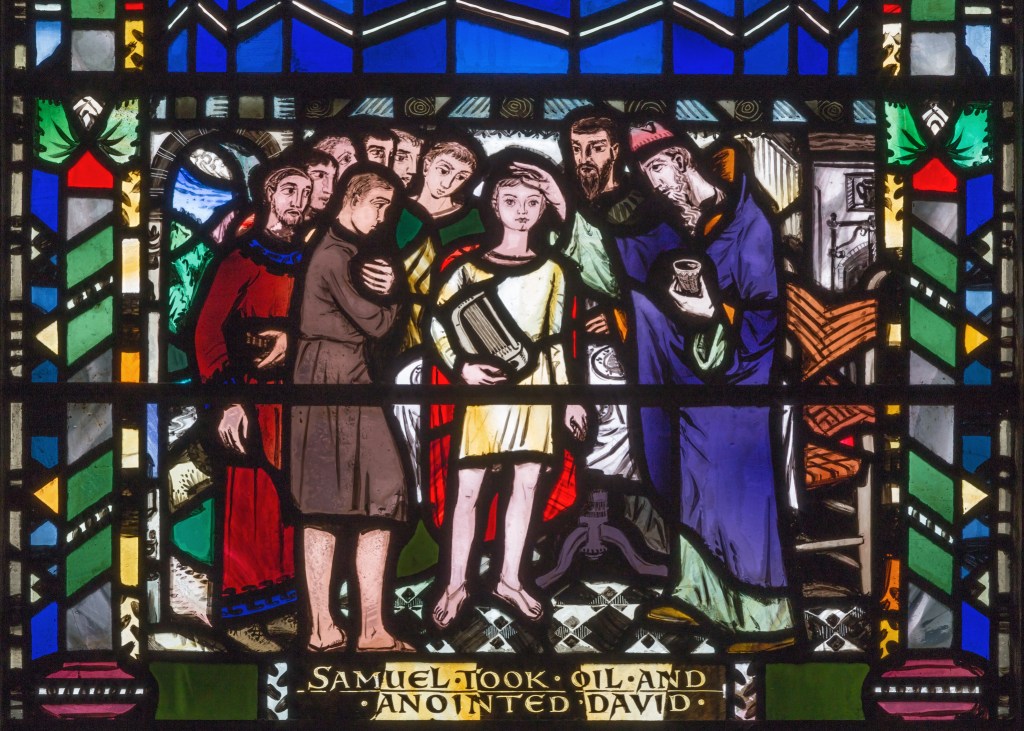
God’s selection is very different from Samuel’s and Jesse’s. People are looking for the biggest and the best. They are enamored with superficial appearances, impressive resumes, and amazing accomplishments. In typical fashion, God flips the script and chooses the youngest son of a local shepherd.
Boot Camp
David’s private anointing slowly started to become evident to others, especially to the reigning King Saul. The time in David’s life between Goliath and David’s public anointing is the long story of God’s real ‘anointed one’ patiently waiting through persecution and suffering, wandering in the wilderness, hiding in caves, and waiting for God to exalt him. David was tempted to become impatient a few times during his journey, but fortunately he had either his conscience, a prophet, or a woman named Abigail, to speak wisdom and encourage him to trust in God and not in his sword or his own plans. Fifteen chapters in the book of 1 Samuel (chapters 16 to 31) tell the story between David’s private anointing, how he dealt with situations, until Saul’s death in chapter 31. In real time that was fifteen years of David’s life where he waited between his private anointing to his public exalting as king. 6
The portrait of David being trained as the Messiah is a picture of someone who is exalted only after they have experienced a lot of hardship. Instead of telling the story of a great king by recounting victories and conquests, the Bible gives this upside-down portrait of a flawed human being who was marked for great suffering. Somehow David got through all that suffering which led to vindication for himself and others. This is what it means to be an ‘anointed one.’ 7

God’s Portrait of awesome
Messiah was God’s response to the blustering and posturing of the nations. At his private anointing, David, God’s Messiah, would not win the people’s choice award as the next leader to challenge the neighbouring kings and nations. God took an obscure boy from a local family and trained him in the school of Messiah – a curriculum of suffering and waiting. After a fifteen-year journey of tests, confusing twists and turns, David graduated to take his place on the throne. Did David see God in all the training? Or did he look back on this time and confess with Jacob, “surely God was in this, and I wasn’t even aware of it.”
Even after being crowned King of Israel, David continued to experience the dual portrait of Messiah – suffering through patient waiting followed by victory. At times, he cried out for help such as when he was surrounded by enemies from his own family [Absalom] who took the throne (Psalm 3). At other times King David was victorious and crushed his enemy (Psalm 2). Being a walking, talking bridge between Heaven and Earth is a mixed bag.
When God wanted to show the Israelites and the neighbouring nations how his rule was greater than anything that they saw around them, and what awesome looked like, he did it very differently from the surrounding nations. Instead of selecting the biggest, strongest, most attractive and influential men, God selected ordinary men from local families and trained them through winds of adversity. As the Jewish people patiently observed David’s progression from shepherd boy to army general to king, they could trust God that the Messiah would represent them well before God, and that he would bring God’s wisdom in his rule over the nation. “The people were turned away from the world’s so-called might, and they were patiently taught to see God’s working in and through Messiah, an anointed one.” 8
Up Next
Promise Maker – What happens when you don’t get what you asked for?
Notes:
- https://www.gotquestions.org/what-does-Messiah-mean.html
- BibleProject Podcast, The Anointed, Episode 3 – Saul the Anti-Anointed, March 27, 2023. https://bibleproject.com/podcast/saul-anti-anointed/
- BibleProject Podcast, The Anointed, Episode 5 –The Anointed King in Psalms, April 10, 2023. https://bibleproject.com/podcast/anointed-king-psalms/
- The Anointed, Episode 5
- NLT Life Application Study Bible, Third Edition (Carol Stream: 2019) p427.
- BibleProject Podcast, The Anointed, Episode 4 – Isaiah’s Anointed One, April 3, 2023. https://bibleproject.com/podcast/isaiahs-anointed-one/
- The Anointed, Episode 5
- Eugene Peterson, Answering God: The Psalms as Tools of Prayer (San Francisco: Harper & Row, 1989) p30.
 Head and Heart Collide
3 thoughts on “Introducing …”